 Health and Safety Policy for Commercial Waste Gerrards Cross
This Health and Safety Policy sets out the commitment of our commercial rubbish company to provide a safe workplace for employees, contractors and clients. It applies across all commercial waste collection and waste management activities we undertake, including scheduled bin collections, skip services and on-site rubbish handling. The purpose of this policy is to define responsibilities, set standards for safe working, and describe the procedures used to manage risk in the provision of commercial waste services in and around the service area.
Our organisation recognises that safety is integral to operational excellence. Senior management will lead by example, ensuring resources are available for training, equipment and monitoring. Employees must follow safe systems of work and report hazards promptly. The policy emphasises continuous improvement and regular review so that our commercial waste services remain aligned with best practice.
Scope, Responsibilities and Definitions
The policy covers all employees, permanent and temporary staff, drivers, loaders, subcontractors and visitors involved in collection, transportation, storage and disposal of commercial rubbish. Key responsibilities include:- Management: ensure risk assessments, safe procedures and training are implemented;
- Supervisors: monitor compliance, provide instruction and ensure PPE is used;
- Employees: follow safe working practices, report incidents and take reasonable care for themselves and others.
Risk Assessment and Safe Systems of Work
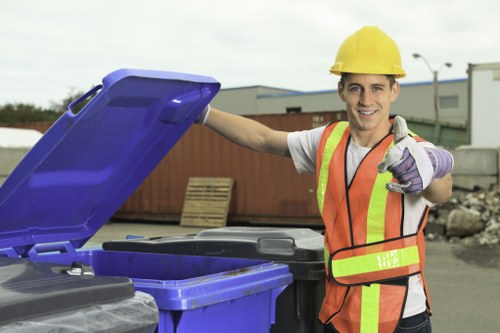
All operations are subject to documented risk assessments that identify hazards, evaluate risks and determine control measures. Controls follow the hierarchy: eliminate, substitute, engineer, administrative and personal protective equipment (PPE). Typical risk areas include vehicle operations, manual handling of bins and sacks, working at height when loading containers, interaction with site personnel and handling of potentially hazardous commercial rubbish.PPE and equipment are selected to match task-specific hazards. Drivers and operatives must wear approved high-visibility clothing, gloves, steel-toe boots and eye protection where appropriate. Mechanical aids, trolleys and lifting equipment are provided to reduce manual handling risk and are inspected on a planned basis.
 Training, Competence and Supervision
Training programmes ensure staff are competent to operate vehicles, use lifting equipment and follow segregation requirements for recyclables and hazardous items. Induction covers company procedures, reporting arrangements and emergency protocols. Refresher training is scheduled regularly and whenever tasks or equipment change. Supervisors carry out on-site checks and coaching to maintain standards in commercial rubbish collection and waste management operations.
Operational Controls and Vehicle Safety
Vehicles used for commercial waste services are maintained to the highest safety standards. Pre-shift vehicle checks, load securing, route planning and driver hours management are enforced to reduce road and workplace incidents. Reversing aids, audible warnings and safe access arrangements are used to protect operatives during collection rounds.Waste segregation procedures minimise cross-contamination and reduce fire risk. Systems identify and separate recyclable materials from general commercial rubbish, and specific controls are in place for any potentially hazardous waste streams. Where hazardous materials are encountered, crews follow a defined isolation and notification process to ensure safe removal.
 Emergency preparedness includes clear onsite evacuation procedures, spillage containment kits, and first aid arrangements appropriate to the scale of operations. Incident reporting and investigation protocols ensure lessons learned are implemented. Records of incidents, near misses and corrective actions are maintained to drive continuous improvement in safety performance.
 Health, Welfare and Wellbeing
The company promotes workforce wellbeing as part of its safety culture. Measures include providing facilities for breaks, access to hydration, temperature management in extreme weather and support for mental health. Policies on fatigue management, shift patterns and safe manual handling practices are applied to reduce occupational health risks associated with rubbish collection and waste handling.
Monitoring and audit activities are undertaken to evaluate compliance with this policy. Performance indicators include training completion rates, incident trends, vehicle inspection records and audit outcomes. Management reviews assess effectiveness and allocate resources to address identified gaps or emerging hazards in commercial waste operations.
Policy Review and Commitment
This Health and Safety Policy for our commercial waste services is reviewed at least annually and whenever significant changes occur in operations, equipment or legislation. The company is committed to maintaining a safe environment for everyone affected by our services and expects full cooperation from all personnel involved in the delivery of commercial rubbish collection and waste management.
Key Points
- Risk assessments and safe systems of work are mandatory for every task.
- Training and competence assurance are required for drivers and operatives.
- Vehicles and equipment are inspected and maintained on a planned schedule.
- Emergency procedures, incident reporting and welfare measures support a safe workforce.
- Continuous monitoring, review and improvement underpin our commitment to safe commercial waste services.
Approval
This document represents the company’s formal health and safety policy for commercial waste operations. Senior leadership endorses the measures described and expects all staff and contractors to comply fully. Failure to adhere to these standards may result in disciplinary action and removal from operational duties until compliance is achieved.
